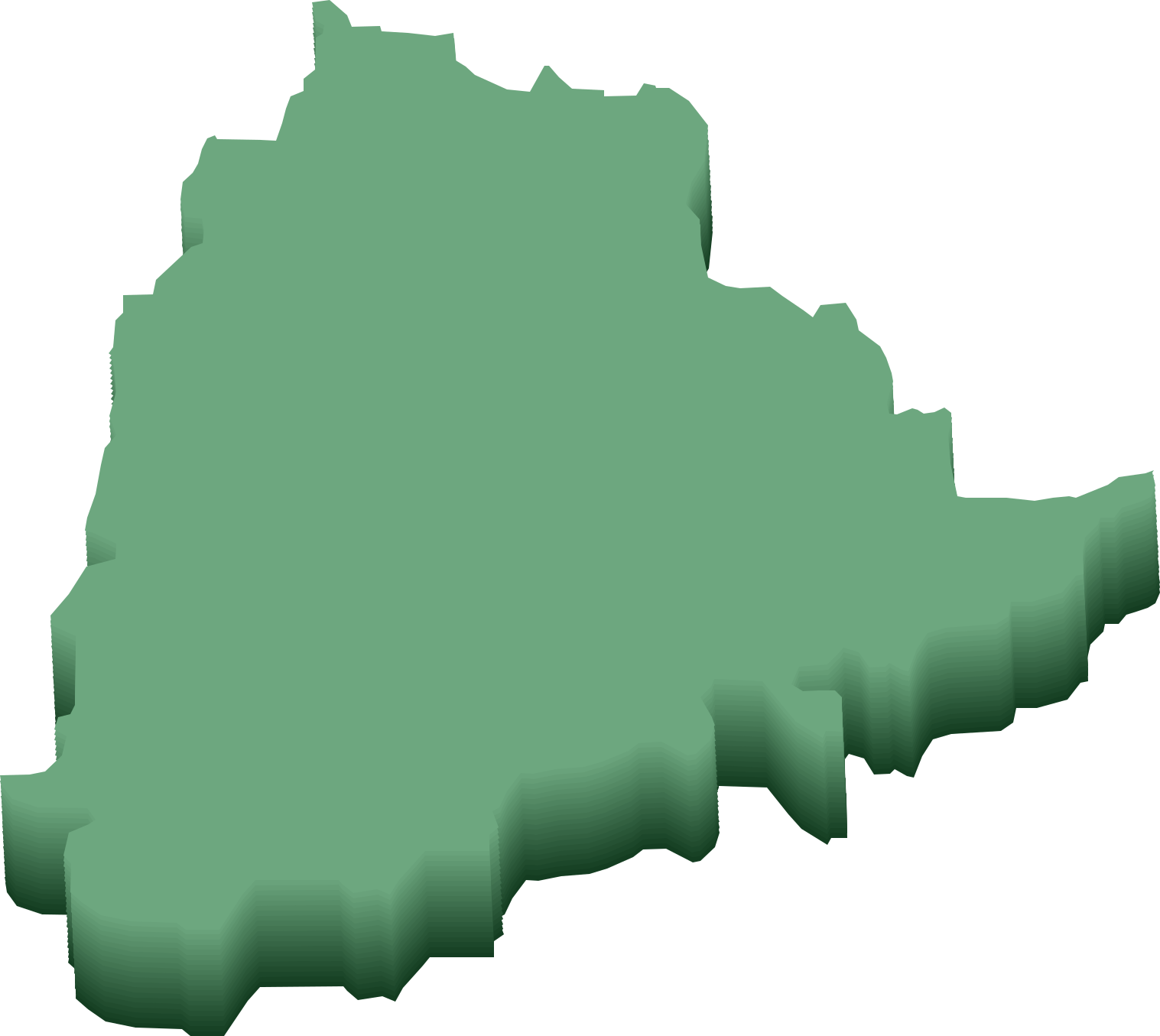
About Rangareddy District (Telangana)
Earlier the district was known as K. V. Ranga Reddy District and it is a district of Telangana state with Vikarabad as its headquarters. It was emerged in the map of Telangana in 1978 when it was split from Hyderabad district. It is the most populous district of Telangana. The district was named after Konda Venkata Ranga Reddy, a freedom fighter who fought for the independence of Telangana from the Nizams and who went on to become the deputy chief minister of Andhra Pradesh.
Geographically, the district lies at 17°39' N latitude, 77°84' E longitude and 526 m altitude. In the year 2023, there was a total 8.59% forest area of total geographical area. The district encompasses an area of 7,493 sq km. and it is bounded by Medak district on the north, Nalgonda district on the east, Mahbubnagar district on the south and Gulbarga district of Karnataka on the west. The chief rivers of the district are Musi River and Kagna River. In context of its climate, the maximum and the minimum temperatures of the district are 30° and 13.6° respectively. Most of its rainfall occurs in the monsoon season. The actual rainfall in the district was 730.4 mm in the year of 2024-2025.
Administrative wise, the district is divided into 14 Assembly constituencies. Moreover, the district comprises 37 sub-districts, 24 towns and 870 villages. The administrative headquarters of the district is located at Vikarabad town. The administrative language in the district is Telugu.
According to 2011 census the district has a population of 52,96,741 including 27,01,008 are males and 25,95,733 are females. The district has a sex ratio of 961 females for every 1000 males. Furthermore, the district has projected population of 64,59,323 comprising 32,98,482 males and 31,60,841 females for the year 2026. According to the National Family Health Survey (NFHS-5, 2019–21), the district has sex ratio of 1,022 females and a child sex ratio of 1,000 females per 1,000 males. During the year 2001-2011 the population growth rate of the district was 48.16% out of which 46.86% were males and 49.54% were females. As per 2011 census the major religions of the district are Hindu and Muslim with 84.18% and 11.66% of the total population. The population density in the district is 707 persons per sq. km. According to 2011 census the principal language in the district are Telugu and Urdu with 78.32% and 10.71%. In the year 2023 the number of live births in the district was 10,441 out of which 5,594 were males and 4,847 were females. In the same year the number of deaths in the district was 6,557 out of which 3,985 were males and 2,572 were females.
Agriculture is the backbone of the Ranga Reddy district. The core agricultural crops of the district are cotton, maize, sugar cane, ground nut, red gram, etc. Some medium-scale industries, Cement Corporation of India (CCI)'s cement factories and Hyderabad Chemical and Fertilizer companies are contributing to its economy to a great extent. Most people in the rural areas of the district are below the poverty line. In 2006 the Indian government announced Ranga Reddy as one of the country's 250 most backward districts (out of a total of 640). It is one of the ten districts in Telangana which currently receiving funds from the Backward Regions Grant Fund Programme (BRGF). In the year 2022-2023 the Gross Domestic Product in the district was Rs. 2,83,41,912 lakh at current price and Rs. 1,53,36,682 lakh at constant 2011-2012 prices. The Net Domestic Product in the district during the period 2015-2016 was Rs. 74,23,357 lakh at current price and Rs. 58,86,429 lakh at constant 2011-2012 prices. The Per Capita Income or NDDP, At Factor Cost in the district during the period 2022-2023 was Rs. 9,46,862 at current price and Rs. 4,97,938 at constant 2011-2012 prices.
The district has numerous professional educational institutes and universities which provide an enormous platform for higher education to the natives of Ranga Reddy. Some reputed universities of the district are Central University of Hyderabad, Jawaharlal Nehru Technological University, NALSAR (National Academy of Legal Studies And Research) University and A.P. Agricultural University. As per 2011 census the literacy rate of the district is 75.87% including 82.11% are males and 69.4% are females. The total number of literates in the district is 35,38,028 including 19,48,784 are males and 15,89,244 are females. In addition, according to the Periodic Labour Force Survey (PLFS) for the period July 2023-June 2024 estimated literacy rate in the district is 89.52% including 94.31% are males and 84.60% are females (Age 7 Years and Above).
Dr. Marri Channa Reddy, an illustrious Indian politician and a leader of Indian National Congress Party was born on 13th January, 1919 at Peddamangalaram village of the district. During his lifetime he was the governor of several states-governor of Uttar Pradesh (1974-1977), governor of Punjab (1982-1983), governor of Rajasthan (1992-1993) and governor of Tamil Nadu from 1993 until his death. He also served as the chief minister of Andhra Pradesh (1978-1980) and (1989-1990).
The district has various sets of tourist places which allures numerous travellers from far distance places. The Ramoji Film City of the district is a film studio complex, which attracts a large number of tourists towards it. Maheshwaram is a well known pilgrimage centre in the district. An ancient Shiva temple and the two fortresses namely Shiva Ganga and Vishnu Ganga are the identity of the place. In the premises of Himayath Sagar Lake of the district there is a small village named Chilkur, which is not only a mesmerising scenic spot, but also a religious site because of its large Balaji temple. Durgam Cheruvu is a significant lake of the district. Its surroundings include unique rock mounds, whose presence marks the boundaries of the plateau of this lake. Keesaragutta, a distinctive hillock situated in the district, which an abode to a thousand of Shiva Lingams. Ocean Park, Shamirpet Lake and Anantagiri Hills are some other renowned centres of attraction in the district.