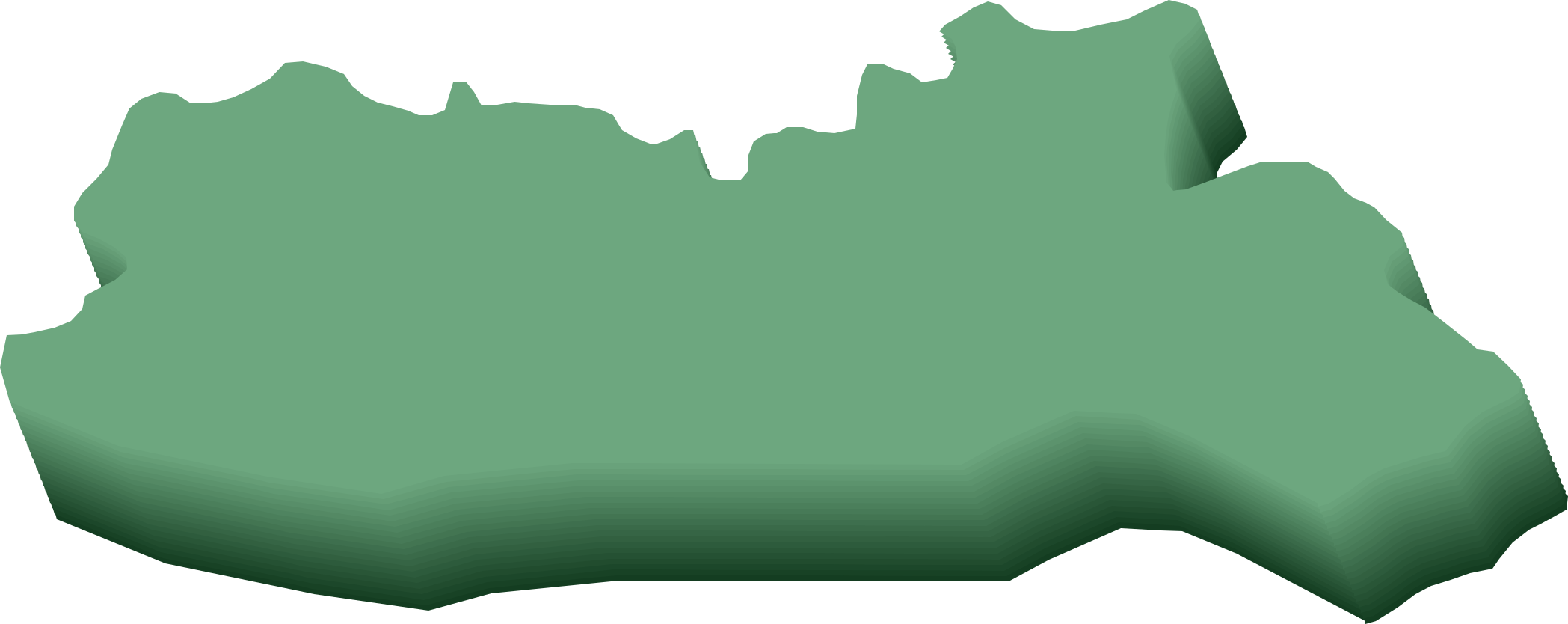
About West Khasi Hills District (Meghalaya)
Historically, the West Khasi Hills district was formed by the split of Khasi Hills district between West and East Khasi Hills districts on 28th October, 1976.
Geographically, the district has a total area of 5,247 sq. km. and occupies the rank 1st in State and 207th in India on the bases of this size. It lies at 25°56' N latitude, 91°29' E longitude and 900 m altitude. In the year 2023, there was a total 80.90% forest area of total geographical area. It is surrounded by Kamrup District, Assam in the North West, by Ri-Bhoi District in the North East, by Bangladesh in the South, by East Khasi Hills District on the East and East Garo Hills District and South Garo Hills District in the West. The principal rivers that flow through the district are Kynshi, Khri, Umngi, Wahblei, Rilang, Riangdo, Tyrsung, Ryndi, Rwiang, Umit Synthi and Btit. Most of the time the climate of the district remains mildly tropical in the northern and southern foothills whereas in the central upland zone it is temperate. The district is also influenced by the South-West monsoon. The actual rainfall in the district was 2914.2 mm in the year of 2024-2025.
Administration wise, West Khasi Hills district is divided into 4 blocks namely Mairang, Mawshynrut, Mawthadraishan and Nongstoin. It has total 2 towns and 1,115 villages. English is its official language. Its district code is 296. The district came into existence on 28th August, 1976 with its administrative headquarters located at Nongstoin, situated at a distance of 94 kms from the state capital.
Demographically, according to the 2011 census, the district has a total number of 63,620 households with a total population of 3,83,461 comprising 1,93,715 are males and 1,89,746 are females which causing it to rank 4th in the State and 561st in India. The density of population of the district is 73 (persons per sq km.). The sex ratio is pegged at 980 (females per 1000 males) while the child ratio stands at 967 (females per 1000 males). Furthermore, the district has projected population of 4,67,627 comprising 2,36,572 males and 2,31,055 females for the year 2026. According to the National Family Health Survey (NFHS-5, 2019–21), the district has an estimated sex ratio of 1,038 females and a child sex ratio of 906 females per 1,000 males. The population growth rate during the period 2001 to 2011 was 29.53% including 28.78% were males and 30.29% were females. In the year 2023 the number of live births in the district was 15,904 out of which 8,023 were males and 7,881 were females. In the same year the number of deaths in the district was 1,311 out of which 790 were males and 521 were females. As per 2011 census the major religion in the district is Christian with 95.68% of the total population. According to 2011 census the principal languages in the district are Khasi and Garo with 54.42% and 12.64%.
Economically, the district is dependent on agriculture primarily. Paddy, maize, millets, potato, ginger, turmeric, oilseed, black pepper, areca nut, betel leaves, plums, pears and peach are major agricultural products of the district. Sericulture, handloom, fishery, animal husbandry industries are also available here. The district is rich in natural resources such as coal, limestone, uranium, etc. In the year 2007-2008 the Gross Domestic Product in the district was Rs. 54,882 lakh at current price and Rs. 40,396 lakh at constant 1999-2000 prices. The Net Domestic Product in the district during the period 2007-2008 was Rs. 48,868 lakh at current price and Rs. 36,567 lakh at constant 1999-2000 prices. The Per Capita Income or NDDP, At Factor Cost in the district during the period 2007-2008 was Rs. 15,233 at current price and Rs. 3,208 at constant 1999-2000 prices.
Education wise, according to 2011 census, the literacy rate is 77.87% out of which 78.53% are males and 77.19% are females. The total number of literates in the district is 2,30,678 including 1,17,307 are males and 1,13,371 are female. The total number of illiterates in the district is 1,52,783 including 76,408 are males and 76,375 are females. In addition, according to the Periodic Labour Force Survey (PLFS) for the period July 2023-June 2024 estimated literacy rate in the district is 95.72% including 94.96% are males and 96.58% are females (Age 7 Years and Above).
Sngap Syiem Memorial College, Nongstoin College, Mairang Presbyterian Science College, Tirot Sing Memorial College, Langtor Hr.sec.school, Balang Mawlangwir Girls Secondary School, Christian Principle Academy, Green Hill School and Anderson Higher Secondary School are some of the main educational institutes in the district.
Martin M. Danggo is serving as the Minister of Parliamentary Affairs in the Government of Meghalaya in present. He is also representative of the Langrin (ST) constituency in the West Khasi Hills district in the Meghalaya Legislative Assembly. Shri Hoping Stone Lyngdoh was the member and the President of the Hill State People's Democratic Party (HSPDP). He became the part of the Assam Legislative Assembly (1962-68) and the Meghalaya Legislative Assembly (1972-2015). He is active in the educational organizations. He also fought against uranium mining in the State.
The district has many famous and beautiful tourist spots which attract tourists from worldwide. These places are Mairang, Jakrem, Mawkyrwat, Mawthadraishan, Nongkhnum Island, Ranikor. Other place is the Langshiang Falls is the 3rd highest waterfalls in India. It has best panoramic views with the surroundings of the green lawn hills. Ranikor is one of the last wild fishing spots left in of Meghalaya. Golden mahseer (fish), Chocolate mahseer (fish), Catfish, eels etc fishes can be found here. Lum Kyllang is also a tourist spot here. It is a massive dome shaped single rock of granite. Natives believe that it has some magnetic powers. Urnar Bah, Kyllaimaram, Umtham, Kathe, Weinia, Shadthum, Langshianng, Umpynsang, Chinmadare, Lawhasngap waterfalls are some other notable places of interest in the district.