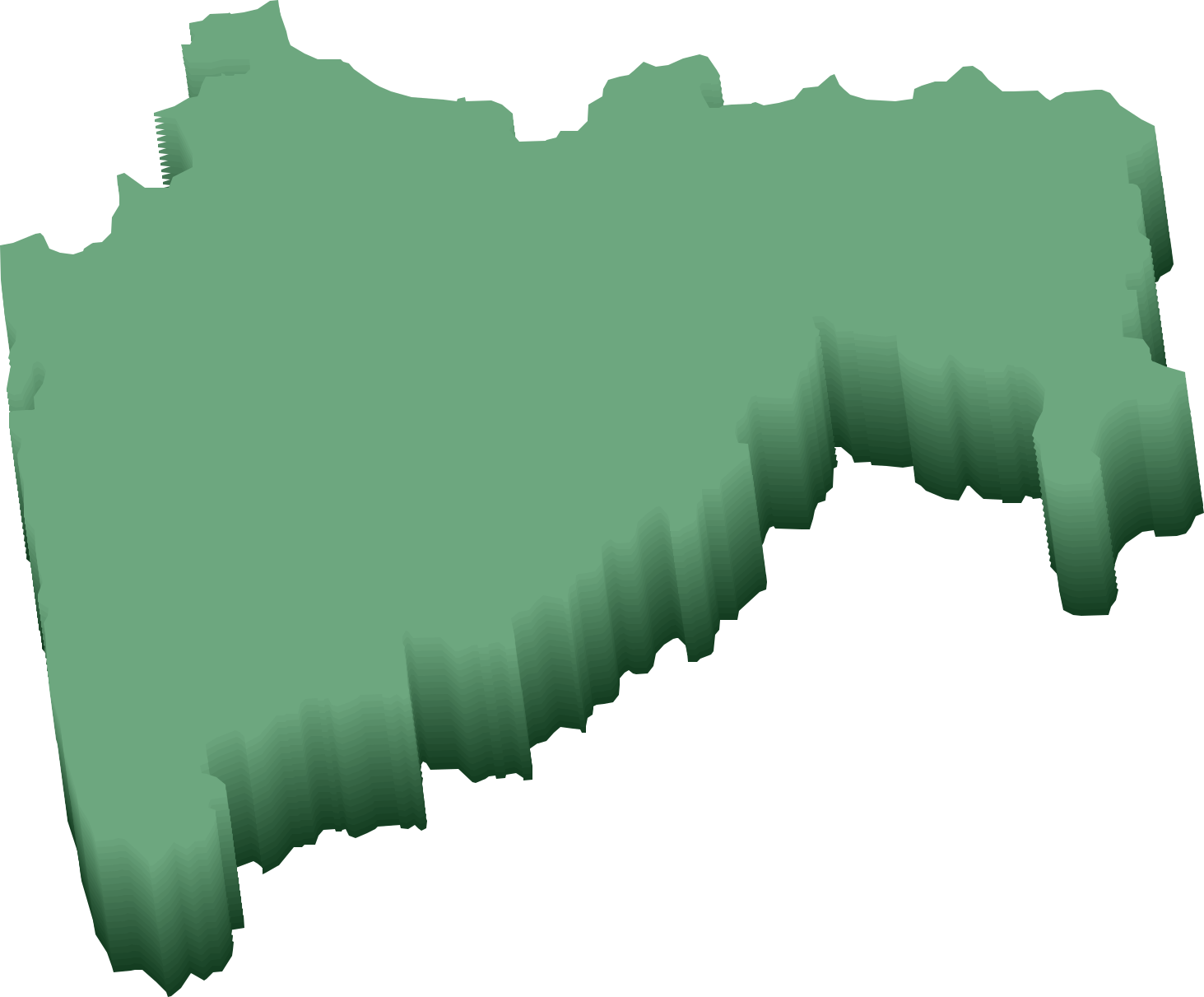
About Jalna District (Maharashtra)
Jalna district, a part of the Aurangabad division is a district of Maharashtra state with its administrative headquarters located at Jalna city. Legends believe that the headquarters city of the district was established as far back as the time of Lord Rama. Moreover, its natives still mark the area where Rama's palace stood. There is also an interesting story associated with the name of the place. Once upon a time there was a wealthy Muslim merchant, who was a great patron of the place since his business of Julaha or weaver was highly flourished in this place and for that very reason the place got its present name Jalna. During different periods of time the place was ruled by different rulers. Before India got its independence, Jalna was a part of the Princely State of Hyderabad but after the Indian independence in 1947, it became a part of Aurangabad district. In the year 1989 when the Jalna district came into existence at that time the city of Jalna became its headquarters. The headquarters city, Jalna is also well known for its sweet limes and it is popularly called as "The City of Sweet Limes”.
Geographically, the district lies at 19°84'N latitude, 75°89'E longitude and 489 m altitude. In the year 2023, there was a total 0.40% forest area of total geographical area. The district encompasses a geographical area of 7,718 sq km. and in terms of geographical area it occupies the ranks of 21st in the state and 116th in India. It is bounded by Jalgaon district on the North, Beed district on the South, Parbhani district and Buldhana district on the East and Aurangabad district on the West. Most of its rainfall occurs in the monsoon season. The actual rainfall in the district was 881.3 mm in the year of 2024-2025.
Administration wise, the district is divided into 8 talukas namely Jalna, Ambad, Bhokardan, Badnapur, Ghansavangi, Partur, Mantha and Jafrabad. Moreover, the district comprises 4 towns and 958 villages. The administrative language in the district is Marathi.
According to 2011 census the district has a population of 19,59,046 out of which 10,11,473 are males and 9,47,573 are females. The district has a sex ratio of 937 females for every 1000 males. Furthermore, the district has an estimated projected population of 23,89,037 comprising 12,35,171 males and 11,53,866 females for the year 2026. According to the National Family Health Survey (NFHS-5, 2019–21), the district has an estimated sex ratio of 948 females and a child sex ratio of 897 females per 1,000 males. During the year 2001-2011 the population growth rate in the district was 21.46% out of which 22.32% were males and 20.54% were females. The population density in the district is 254 persons per sq. km. In the year 2023 the number of live births in the district was 40,303 out of which 21,699 were males and 18,604 were females. In the same year the number of deaths in the district was 8,568 out of which 5,715 were males and 2,853 were females. As per 2011 census the major religion in the district is Hindu with 76.80% of the total population. According to 2011 census the principal languages in the district are Marathi and Hindi with 76.16% and 13.14%.
Agriculture is the backbone of the economy of the district. Most of the lands in the district are use for agricultural purposes. More than half of its population are engaged in agriculture in order to earn their livelihood. The chief agricultural products in the district are wheat, cotton, etc. Every year a huge chunk of revenue comes from the agricultural sector of the district helps in its economy to a great extent. The district is scantily industrialised since it has only a few steel re-rolling mills, cigarette industry and pulses mill. In the year 2023-2024 the Gross Domestic Product in the district was Rs. 42,80,400 lakh at current price and Rs. 25,68,300 lakh at constant 2011-2012 prices. The Net Domestic Product in the district during the period 2023-2024 was Rs. 38,03,500 lakh at current price and Rs. 22,65,000 lakh at constant 2011-2012 prices. The Per Capita Income or NDDP, At Factor Cost in the district during the period 2023-2024 was Rs. 1,78,329 at current price and Rs. 1,06,197 at constant 2011-2012 prices.
The district is well-known as an abode of several reputed educational institutions. It provides a platform for higher education. Some of its recognised educational institutions are Agricultural College, Badrinarayana Barwala Mahavidyalaya, Dharati Janseva Pratishthan College of Engineering & Technology, Guru Mishri Homeopathic College, Rashtramata Indira Gandhi College, Marathi Kanyapath Shala (University), etc. As per 2011 census the literacy rate in the district is 71.52% including 81.53% are males and 60.95% are females. In addition, according to the Periodic Labour Force Survey (PLFS) for the period July 2023-June 2024 estimated literacy rate in the district is 82.71% including 91.15% are males and 72.79% are females (Age 7 Years and Above).
Arjun Panditrao Khotkar, a veteran politician from the Shiv Sena political party was born on 1st January, 1962 in the Jalna district. At present, he is a Member of the Legislative Assembly from Jalna assembly constituency. He was also served as the Minister of state in the 1999, Shiv Sena Government.
The district has several centres of attraction which allures many travellers from different parts of the country as well as world. Matsyodari Devi Temple situated at a distance of 21 km. in the southern part of the Jalna city. The temple is called as Matsyodari temple because it resembles the shape of a fish (matsya). Yogeshwari Devi temple, situated in the Yogeshwari Nagar of the Old Jalna was built by Shri Ganpatrao Agnihotri in the year 1990. Many pilgrims from different parts of the country come to this place in order to offer their prayers. Some other places of interest in the district are Jalna Fort, Moti Talab, Ghanewadi Talab, Dargah of Zacha and Bacha, Dargah of Nur Shah Wali, Guru Ganesh Bhavan, Shri Jagdamba Devi Mandir, Shri Anandi Swami Mandir and many more.